Your assistant.
Your agent team.
Your own computers.
Kritaqo brings conversations, projects and visible AI teamwork into one approachable workspace. Users choose a lead assistant, connect their own model accounts or API keys, and access work running on their computers from a laptop or phone.
The problem and the first audience
Using several AI assistants often means switching tools, repeating context and losing track of which computer holds a project. Kritaqo starts with individuals and independent professionals who want help planning, learning and completing practical project tasks without assembling a technical agent stack.
The idea grew from the founder’s own setup: a mini PC at home, a Windows laptop and a phone used remotely. Ease of setup and a clear view of what each agent is doing are the product’s priorities.
How the alpha works
- Install Kritaqo and connect a supported model account or an optional provider API key.
- Choose the lead assistant. Work in a conversation or invite a planner and reviewer, with different models available for the roles.
- Follow each role’s contribution and receive one final answer from the coordinator.
- Pair your computers to see their projects in one panel. Connect remotely to the computer running the work.
The workspace runs on user-owned hardware. Cloud requests send task content to the selected model provider. API usage is billed by that provider; local models are available through Ollama.
What has been demonstrated
- Windows app experience: installation, opening in a separate app window, and returning to the saved conversation and model after closing it.
- Visible AI teamwork: three models taking three roles and producing a combined final answer in a user test.
- Connected devices: the mini PC’s projects visible from the Windows panel, plus remote phone access in the founder’s setup.
- Provider choice: tested account-based responses and local-model support; an implemented API-key path for five providers awaits live API validation.
These are internal tests and founder-reported alpha results. First-time external tester onboarding and broader reliability validation are still ahead.
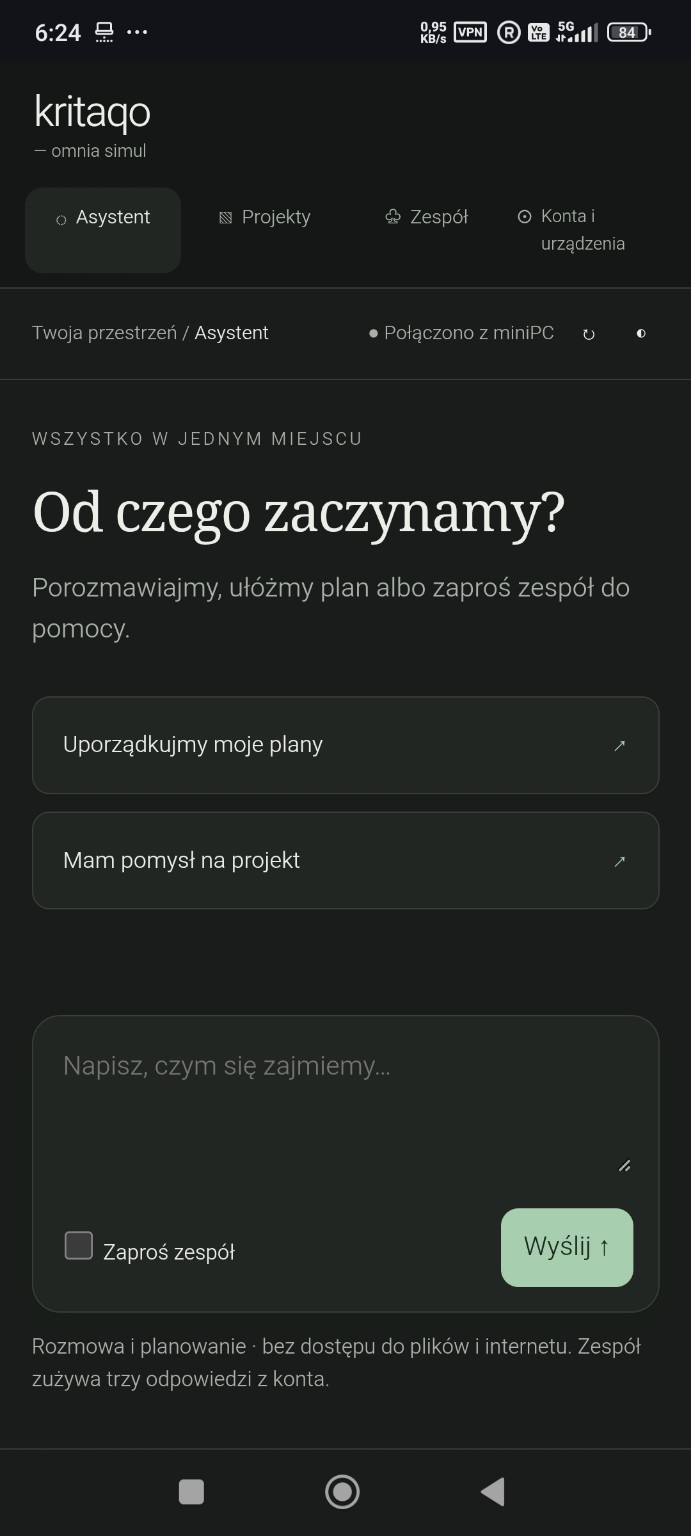
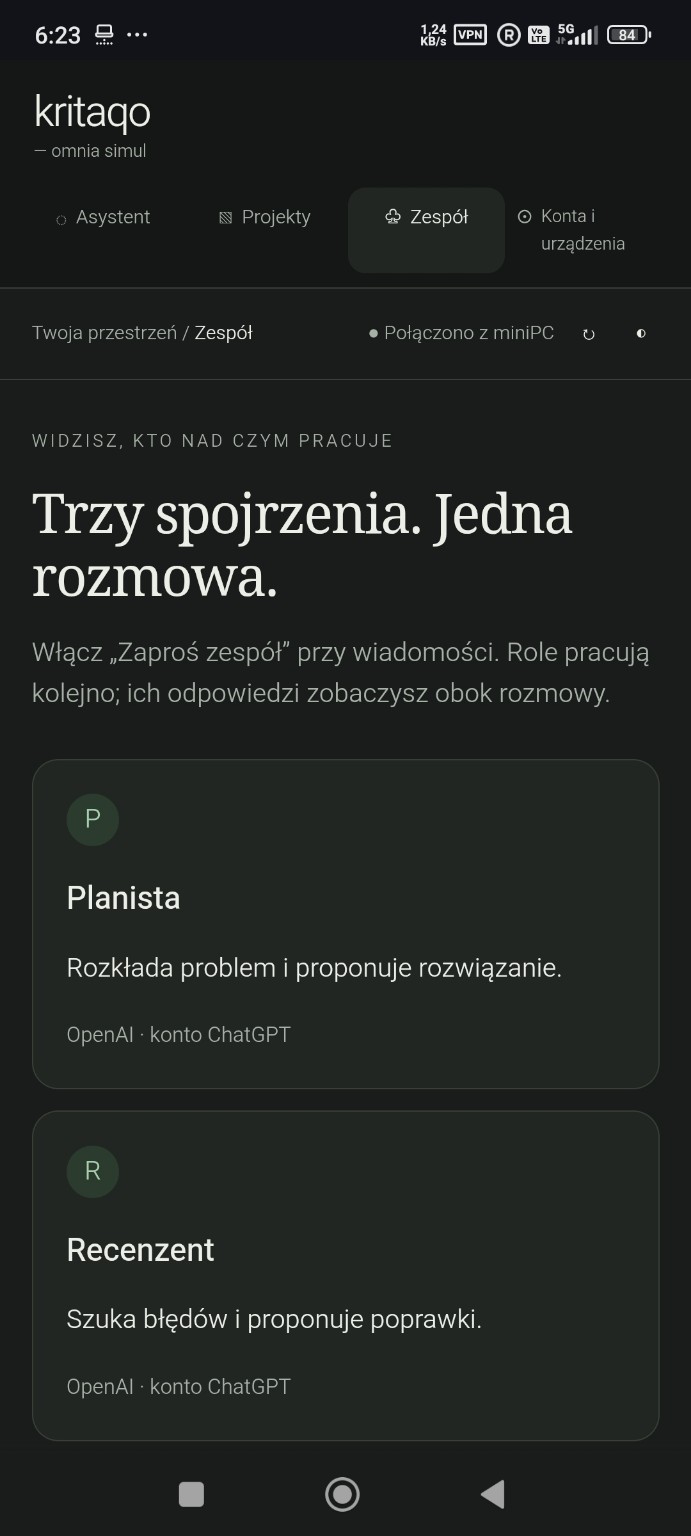
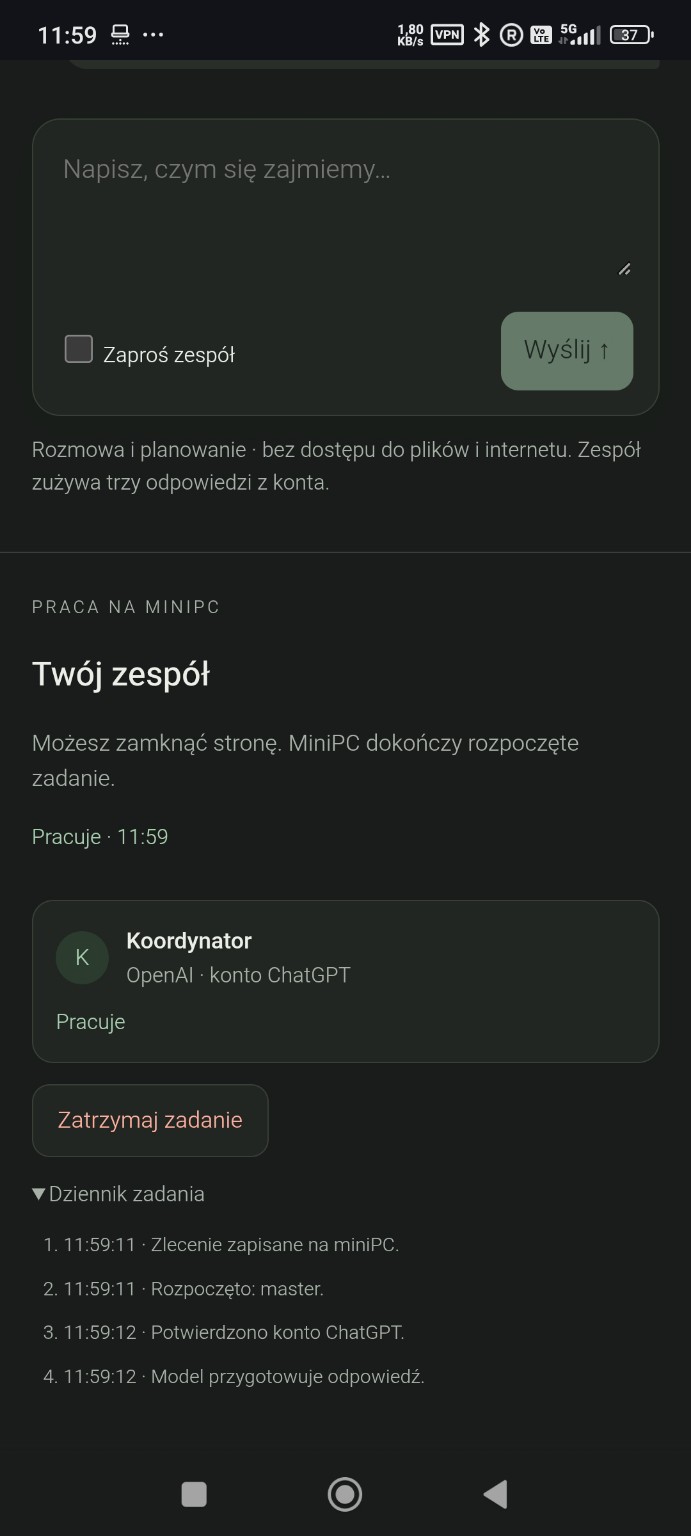
Actual prototype screens. The interface shown is in Polish.
Where Claude fits
Kritaqo includes an adapter for the Anthropic API using a user-supplied key. Live validation of that direct integration is pending. A Claude model has answered successfully through a separate provider connection; that result does not validate the direct Anthropic API.
We plan to evaluate Claude as the lead assistant, planner and reviewer through Anthropic’s API. Initial development work will measure answer quality, context continuity, cancellation, error handling and usage cost on bounded tasks. This will inform a reliable, understandable Claude experience inside a workspace that preserves the user’s model choice.
The next milestones
- Validate direct Claude API responses and multi-role workflows on Linux and Windows.
- Have first-time testers install the app, connect their own accounts and complete a task without developer assistance.
- Simplify remote pairing and updates, and test interruption and reconnect scenarios.
Today, remote access requires Tailscale and an awake host. Windows project command execution is disabled. Project history and task actions require the source computer to be online; only the last known project list remains visible offline.
Business direction
Kritaqo is currently Eryk’s personal project, with the intention of establishing a business. A company has not yet been registered.
The intended model is a paid application license, with model usage paid directly by users to their chosen providers. Pricing and paid licensing are not launched. Shared workspaces for human teams are a later expansion, after the individual workflow is validated.